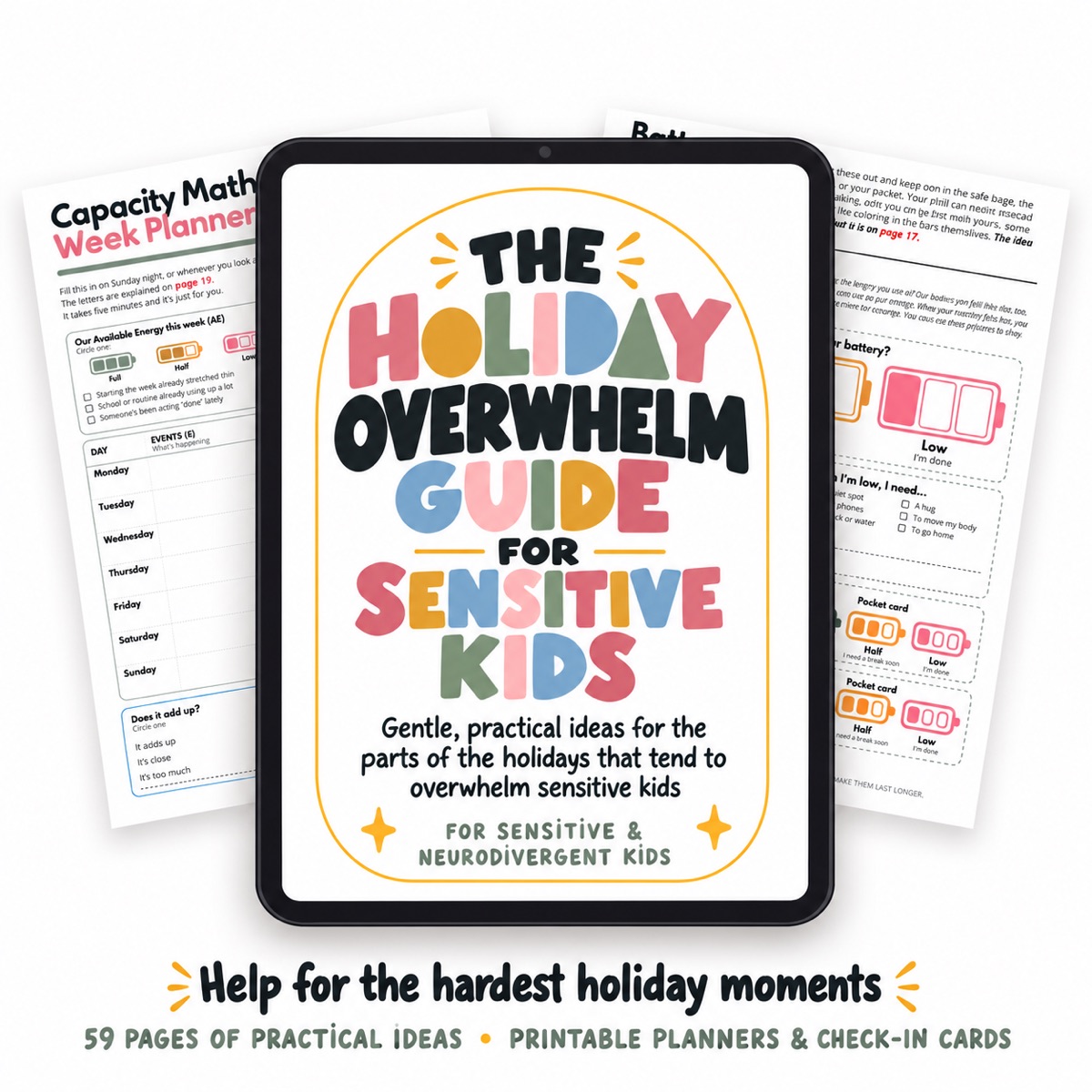
Make the holidays easier on your sensitive kid, and on you.
They've been counting down for weeks. You're already bracing for the relatives with opinions, the dinner that runs two hours late, and the car ride home. This guide gives you specific things to try for each of those moments, plus what to do when your kid says no to all of it.
Instant PDF download · 59 pages · 5 printables · Read it on your phone tonight
Start before the first big gathering.
What to say when relatives push the hug, the bite, or "leaving already?"
A quick way to spot an overfull week before anyone hits their limit
Ideas for when every kind of help gets a no, including the break
Pages for Thanksgiving, gift morning, travel, concerts, New Year's and two homes
5 printables, like battery check in cards your kid can point to
Written by Kate, a highly sensitive mom raising three neurodivergent, highly sensitive kids. Find her on Instagram.
holiday overwhelm in real life
Sound familiar?
Your child spends weeks looking forward to seeing their cousins, then wants to leave twenty minutes after arriving.
The holiday outfit they loved yesterday suddenly feels unbearable.
Everyone is excited to open gifts, but your child needs time with each one while the rest of the family keeps moving.
You offer a break because you can see they're overwhelmed, and somehow the suggestion makes everything worse.
The gathering goes surprisingly well, but the car ride home or the next morning is another story.
You probably already know your child needs something different in these moments. Figuring out what that looks like in the middle of real holiday plans is the hard part.
That's what this guide is for.
Your child can spend weeks looking forward to the holidays and still have a hard time with everything that comes with them.
This guide goes beyond the usual sensory tips, with practical ideas for Thanksgiving, Christmas, family gatherings, gift days, travel, and all the tricky moments in between.
From handling relatives' expectations to planning around your child's capacity and figuring out what to do when even your help gets a no, you'll have specific ideas and printable tools to turn to throughout the season.
Demands hiding in December
TimeBe ready by four. Ten more minutes. Time to go.
MannersSay hi, hug Grandpa, say thank you, smile.
FoodSit down, try a bite, eat at the table.
ClothesThe dress, the tights, the matching pajamas for the photo.
Even the fun partsOpen your present, come see the lights, make a wish.
0asks so far
Each one is small. By dinner it's dozens, and the fun ones count too.
straight from the guide
Two things you can use at the first gathering
Replies for the comments you already know are coming, and a battery your kid can point to before they run out.
Words you can borrow
12%
GRJFamily ›
GrandmaCan't wait to see you all! Make sure he gives Grandma a big hug!! 🤗He'll say hi when he's ready. Come tell me about the drive!Aunt JenI'm making my famous casserole. She can just try one bite 😊We're keeping food easy today. Thanks for thinking of her.Uncle RobYou're leaving already??We're heading out while it's still fun. Thanks for having us!Read 6:42 PM
iMessage↑
Ready to say lines for the comments you already know are coming, like the hug, the bite and "leaving already?"
Catch it before it's empty
Drains it
Late night
Long car ride
All the hellos
Loud room
FullNeed a break soonI'm done
Fills it
Quiet room
Headphones
A snack
Moving their body
Printable battery check in cards your kid can point to, so you know when to take a break.
For highly sensitive, ADHD, autistic, and easily overwhelmed kids, even the most anticipated holiday activities can become difficult. Each part of the guide is packed with real life examples and specific things to try.
Part oneBefore the holidays get busy
Part twoFor the moments that get difficult
Part threeFor the actual holidays
Part fourFor travel and time away from home
Part fiveFor the hours and days after
Part one
Before the holidays get busy
Understand what's adding up before your child reaches their limit.
Recognize early signs of overwhelm, including the quieter ones.
Understand how excitement, sleep, hunger, sensory input, demands, and transitions can add up.
Use the Capacity Math approach to look at an entire week of plans.
Create Bronze, Silver, and Gold versions of holiday outings, from the smallest version to the full experience.
Identify what matters most so every tradition doesn't have to compete for the same time and energy.
Part two
For the moments that get difficult
Practical ideas for the situations parents find themselves navigating every year.
What to try when your child refuses the break you're offering.
How to make waiting, arriving, and leaving easier.
Ways to adjust noisy stores, restaurants, and family gatherings.
Ideas for movement, heavy work, quieter spaces, and familiar comforts.
What to say when relatives question your child's needs or expectations.
How to make room for connection when everyone is already stretched thin.
Part three
For the actual holidays
Dedicated pages for the events and traditions families are preparing for.
Thanksgiving and big holiday meals
Family gatherings and visits with relatives
Gift opening days and unexpected presents
School concerts, parties, and parades
Hosting celebrations at home
Holidays across two households
New Year's Eve
Halloween and trick or treating
Part four
For travel and time away from home
Because the trip itself can be just as demanding as the holiday.
Planning around your child's energy before booking
Airport waiting and travel day activities
Making long drives and flights more manageable
Portable tools and activities worth exploring
Preparing for unfamiliar hotels and sleeping arrangements
Protecting downtime after a long travel day
Part five
For the hours and days after
The holiday may be over, but your child may still be processing everything that came with it.
What recovery can look like after an exciting day
Ideas for protecting the first hour home
Familiar routines and activities that may help your child settle
Planning lighter days after big events
Making room for your own energy and needs, too
Plan the first hour homeHow to think through the first hour after arriving home, when everyone is spent.
your whole season
From Thanksgiving to New Year's Eve
Pages for each of the big days, and the busy weeks in between.
NovDecJan
Thanksgivingbig holiday meals
School concertsparties and parades
Travellong drives and flights
Gift morningand family gatherings
New Year's Evelate nights and countdowns
What's Included?
Practical, real life support for the holidays and all the moments in between.
Go straight to the situation you need help with. Each page is laid out so you can find an idea quickly, even on a busy day.
Big Family GatheringsPractical ways to prepare for arriving, participating, and leaving.Too Loud, Too Bright, Too MuchSmall adjustments for noise, light, clothing, and busy spaces.What Might Be Underneath the BehaviorExplore possible reasons and practical things to try.
Tap a cardfor a few possible reasons
Sometimes they need less
Ideas from the guide for turning the day down a notch.
Fewer faces. One trusted adult in a smaller room.
Less to look at. A hood up, sunglasses, a seat facing the wall.
Fewer words. Short sentences, a quiet voice, and no questions for a few minutes.
Less noise. Headphones, a closed door, the car with the radio off.
Less to decide. Make the small calls for them for a while: what to eat, where to sit.
print them, save them, or skip them
Five printable tools included
These are designed to help you use what you're learning without having to remember everything.
01
Capacity Math Week Planner
Look at upcoming events, transitions, available energy, and the recovery time your family may need.
02
The Hidden Load Checklist
Check what might already be adding up before leaving for a gathering or outing.
03
One Page Event Planner
Plan smaller versions of an event, think through difficult moments, organize familiar supports, and decide how you'll handle leaving.
04
Battery Check In Cards
Printable cards your child can point to, color, or use to communicate when they need something different.
05
Your Child's Holiday Pattern
Notice early warning signs, record what helps, and keep the information you want to remember next year.
printable included
The Hidden Load Checklist
Tick what's already true before you leave the house.
SensoryNoiseScratchy or new clothesCrowds
SocialLots of peopleHugs and greetingsQuestions from adults
RoutineLate night yesterdayMeals at odd timesLong drive
printable included
Capacity Math Week Planner
A five minute look at the week before it starts.
E eventT transitionR recovery
Do the Capacity MathLook at the whole week, including transitions and time to recover.The Hidden Load ChecklistSee what might already be adding up before a big day.Battery Check In CardsPrintable ways to explore how much energy your child has left.
Print them, save them, or use the ideas without filling anything out. Whatever fits your family.
You don't need to do more to make the holidays better.
You might already be doing some of these things. Others may not fit your child, your family's values, your budget, or the energy you have available.
There are ideas that cost nothing, activities that use things you already have, and ways to adjust plans without needing to create an entirely new holiday experience.
You don't need to buy a collection of sensory equipment, fill every quiet moment with an activity, or turn every difficult situation into something to work on.
1Start with whatever your family has coming up.
2Find that section.
3Take a few ideas that seem useful.
The rest will still be there when you need it.
a note from me
Hi, I'm Kate.
I'm the mom behind Sensory Learners Club. I'm a highly sensitive person raising three neurodivergent, highly sensitive kids, and this guide grew out of our family's lived experiences.
For kids like mine, the holidays brought a lot at once. Music in every store, an itchy outfit for the photo, a house full of relatives who want hugs, dinner two hours late, and bedtimes that slide later every night. They can count down for weeks and still run out of room for all of it.
Sometimes that looks like a meltdown. Sometimes it looks like a kid who goes quiet, gets bossy, or says no to everything, including the help you're offering. A lot of the time it comes out later, in the car or the next morning. And you're usually handling all of it while relatives watch and the schedule keeps moving.
The plans we've changed. The situations we didn't anticipate. The things we've tried that helped, and the ones that didn't.
I wanted to put together something parents could turn to when a particular situation gets hard: a collection of ideas, examples, and practical tools you can tweak to make your own.
I hope it helps you find a little more room for the parts of the season your family genuinely enjoys.
Kate
everything you need to get started
Get the guide
The Holiday Overwhelm Guide for Sensitive Kids
Complete 59 page digital guide
Practical ideas across the major holidays, family gatherings, travel, and recovery
Real life examples and suggestions organized by situation
Five printable planning and reflection tools
PDF access on your phone, tablet, or computer
PDFThe Holiday Overwhelm Guide59 pages plus 5 printables
Digital download. No physical product will be shipped.
questions parents ask
Frequently asked questions
Is this only for autistic or ADHD kids?
No. It's written for parents of highly sensitive, sensory sensitive, ADHD, autistic, PDA, and easily overwhelmed children, with or without a formal diagnosis.
What ages is it best for?
It's written for kids ages 3 to 12. Some ideas suit younger kids best, like pointing to a battery card to show how they feel, and some suit older kids, like helping plan their own day. Pick the ones that fit your child's needs, interests and safety.
Do I need to buy any sensory equipment?
No. Many ideas involve adjusting expectations, making familiar activities available, planning differently, or changing the environment. Product suggestions are optional.
Do I have to read all 59 pages?
No. The guide is organized so you can go straight to the situation you need help with. You can use it as a reference throughout the season.
Can I print the guide?
Yes, for your personal household use. You can print the included planners, checklists, and battery cards as often as you need for your own family.
Is this professional therapy or medical advice?
No. This is an educational resource created from a parent's perspective. It shares general information, practical ideas, and lived experience and does not replace individualized guidance from qualified professionals.